What inspired you to pursue your current field of study/research?
My interest in nanomedicine began when I started working at the Nanomedicine Innovation Center at Northeastern University. Through this experience, I was introduced to the field of nanomedicine and its wide range of applications in healthcare and research. Working in the lab exposed me to innovative technologies and interdisciplinary approaches that combined biology, chemistry, and nanoscience to address real-world medical challenges. The experience made me realize how impactful and rapidly evolving the field is, and it inspired me to explore it further through both research and coursework. This growing interest motivated me to take courses in the Nanomedicine program and eventually pursue a Graduate Certificate in Nanomedicine alongside my master’s degree.
Have you participated in any co-op or study abroad programs? How was that experience?
My co-op experience had a significant impact on my academic and career direction. When I began my master’s program, I was certain that my path would be to graduate and work in a biotech company, which is a common trajectory in the program.
Prior to my co-op, I had spent a year working in an academic lab, where I developed a strong interest in research and particularly enjoyed the independence it offered. I entered my co-op expecting that an industry setting would be more structured and aligned with my long-term goals.
However, during the experience, I realized that the role I was primarily focused on end stage CMC work which did not provide the level of research involvement or intellectual independence I was looking for.
Although this was initially challenging, it became a very valuable learning experience. It helped me understand what I do not want in a long-term career, which is just as important as identifying what I do want. It also gave me the opportunity to explore an industry environment in a time bound setting without the commitment of a full-time role.
As a result, I gained greater clarity about my future direction and now plan to pursue a PhD after completing my master’s degree. I don’t think I would have reached this level of clarity without the perspective I gained through my co-op experience.
What kind of extracurricular activities are you involved in?
I have been actively involved in several extracurricular and leadership activities throughout my graduate studies. I served as an Academic Affairs Senator in the Graduate Student Government, where I worked closely with fellow graduate students to understand their concerns, improve academic experience, and help organize events that support students’ professional and personal development.
I am also part of the Peer Pathway Program, where I initially joined as a mentee and later became a mentor. This program played an important role in helping me adjust to a new city and navigate graduate school. As a mentor, I aimed to provide the same guidance and support I received, while also building meaningful connections with other students.
In addition, I completed the GLI course offered by the Center for Student Involvement, which helped me develop a broader understanding of leadership. It strengthened my ability to work in team settings and gave me practical insights that I can apply in both academic and professional environments.
What has been the highlight of your experience in COS so far?
One of the highlights of my experience in the College of Science has been my involvement in nanomedicine through both coursework and research. The Nanomedicine course taught by Dr. Ahmed Atef was especially impactful because of the independence it gave students to design their own study plans and experimental approaches. This was a very different and enriching experience compared to traditional structured lab courses.
In the course, we worked on the design of multifunctional nanoparticles for in vivo drug delivery and imaging, while also evaluating methods and instrumentation for nanoparticle synthesis and characterization. As part of our project, we synthesized lipid nanoparticles loaded with a chemotherapeutic drug and designed and executed in vitro protocols for their analysis. This experience helped me strengthen my problem-solving skills, scientific independence, and confidence in experimental design.
Alongside the course, I also had the opportunity to work as a research assistant at the Nanomedicine Research Center, which made the overall experience even more meaningful. Through this role, I gained hands-on experience with both in vivo and in vitro work for ongoing studies in the lab. Being involved in both coursework and active research allowed me to better understand the real-world applications of nanomedicine and helped me further develop my technical and analytical skills.
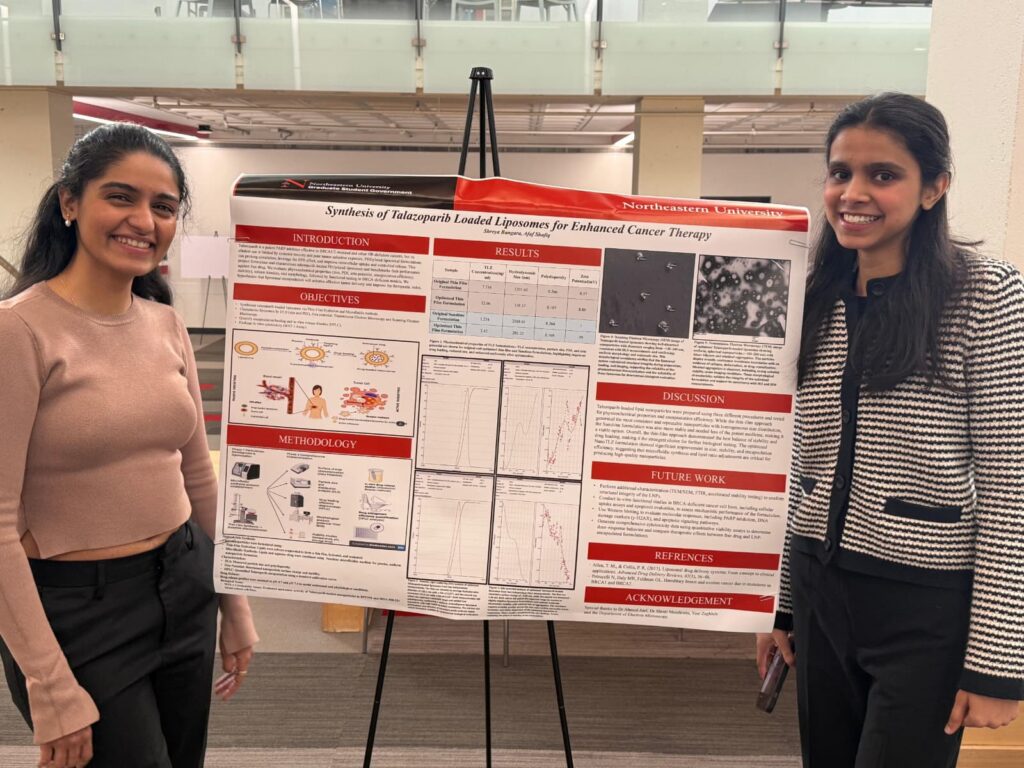
The findings from our work were later presented at the IMPACT Symposium, where our team won second place. This experience strengthened my scientific communication and presentation skills while giving me confidence in presenting research to a broader audience. Overall, these experiences have played a major role in shaping my academic journey and preparing me for future opportunities in research and biotechnology.
Have you had any professors or mentors who really made an impact on you?
Yes, Dr. Ahmed Atef from the Nanomedicine program has had a meaningful impact on my academic and research journey. Working with him at the Nanomedicine Innovation Center was an incredibly valuable learning experience, and his mentorship helped shape the way I approach research, experimental design, and problem solving. He also had a great impact on preparing me for my co-op interviews by providing guidance, encouragement, and advice that helped me feel more confident professionally. His mentorship and support have given me skills and perspectives that I know will continue to help me in the future.
Where do you see your field of study/research taking you?
I plan on pursuing a PhD as my next step. Through my academic and research experiences, I’ve developed a strong interest in deepening my understanding of biotechnology and nanomedicine, particularly in areas that bridge fundamental research with translational applications. My co-op and lab experiences helped me realize that I am most motivated in research-driven environments where I can contribute to problem-solving in a more independent and exploratory way.
In the long term, I see myself continuing in research, ideally in an academic or industry R&D setting, where I can contribute to the development of innovative therapeutic and drug delivery technologies. My goal is to build a career where I can stay closely connected to scientific discovery while also working on solutions that have real-world biomedical impact.
What kind of impact do you hope to make after you leave Northeastern?
I hope to contribute to meaningful research that in the long term can help improve patient outcomes and advance healthcare. Being part of scientific work that eventually translates into real-world applications for patients is something that strongly motivates me.
As a first-generation student choosing a career in science, I also deeply understand the importance of mentorship. Since mentorship played a significant role in helping me navigate my academic journey, I would like to give back in the same way. I hope to support and guide students who are going through similar paths, helping them feel more confident and less uncertain as they build their own careers.
What advice would you give students interested in pursuing a degree in science?
I would advise students interested in pursuing a degree in science to develop patience, especially if they are research oriented. There will be days when you work extremely hard but do not immediately see results, and that can feel discouraging. The same mindset is also important when searching for co-ops. It requires patience and consistency, even when there are rejections or periods of uncertainty, because you never know when the right opportunity will come along.
Staying persistent and continuing to put in effort whether in research or applications makes a big difference in the long run. Ultimately, science and career development both take time, and maintaining hope while staying consistent is key, because the right opportunity often comes when you least expect it.