Imagine this.
You pick up a contact lens from its container and — yikes! — it falls on the bathroom floor. Before you know it, your cat pounces, claws out. By the time you wrestle it back, the lens looks like a tiny chew toy.
And then, just like that — the scratches fade away and the ripped edge seals itself up.
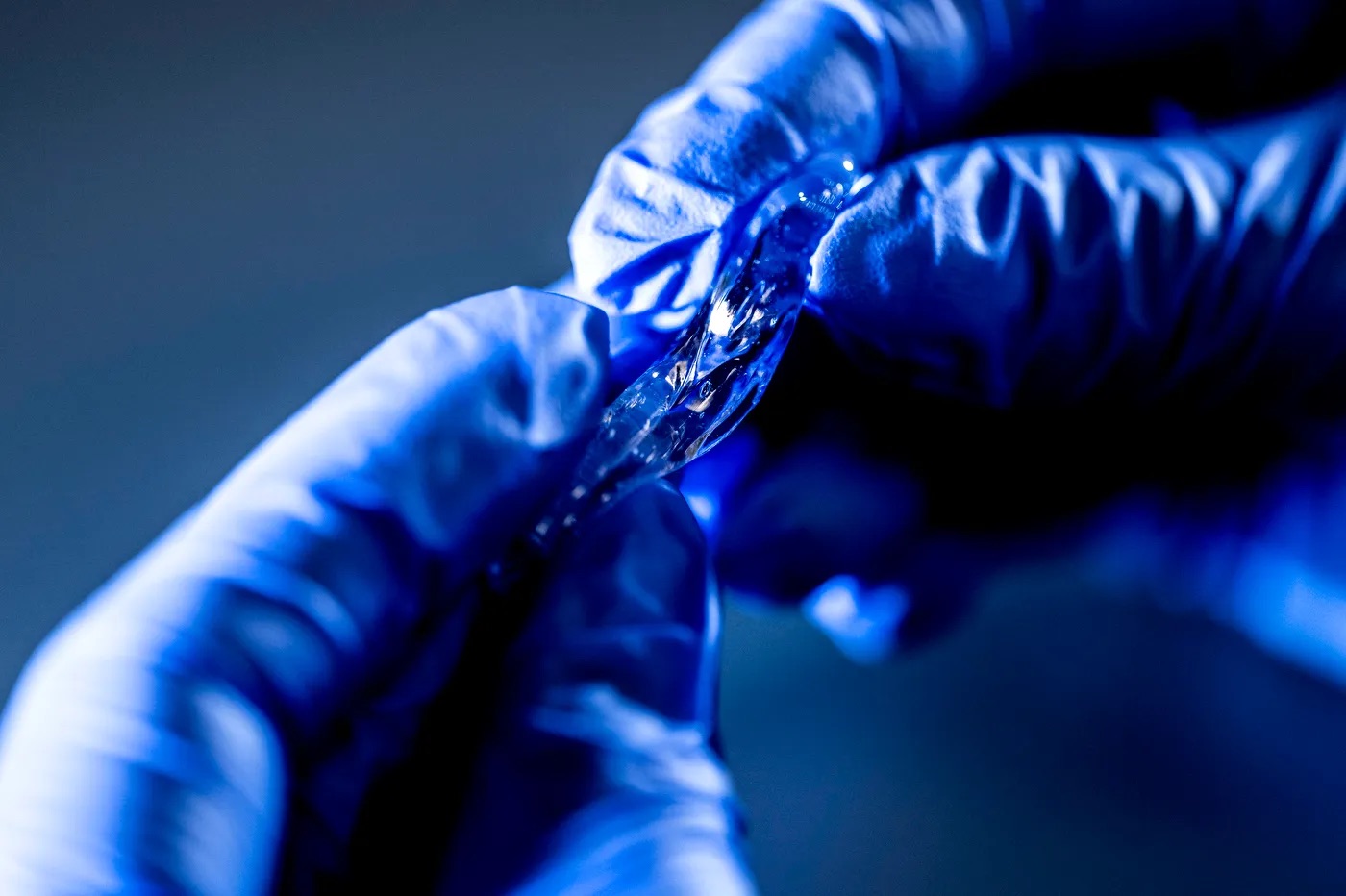
Lenses that repair themselves aren’t on the market yet. But the self-healing material used to make them is very real. One particular type was created by Northeastern University chemistry and chemical biology professor Diego M. Alzate-Sánchez and Ph.D. student Jenna King. It belongs to a large group of materials known as hydrogels. As they report in a recent Advanced Materials paper titled “True Closed-Loop Recyclable Hydrogels Enabled by Imine Boronic Ester Crosslinking,” it’s also fully recyclable.
Hydrogels act a bit like sponges, stashing large amounts of water in their internal network of long molecular chains called polymers.
The polymer structure is reinforced by crosslinks — so-called “permanent bonds” that form when shorter molecules called crosslinkers bind to the long chains, keeping them connected to one another.
Crosslinks are chemical superglue — breaking them is notoriously difficult.
“Once you make that material, there’s no way to dissolve (it) in any sort of solvent,” King explained.
Read more at Northeastern Global News
Photo by Matthew Modoono/Northeastern University