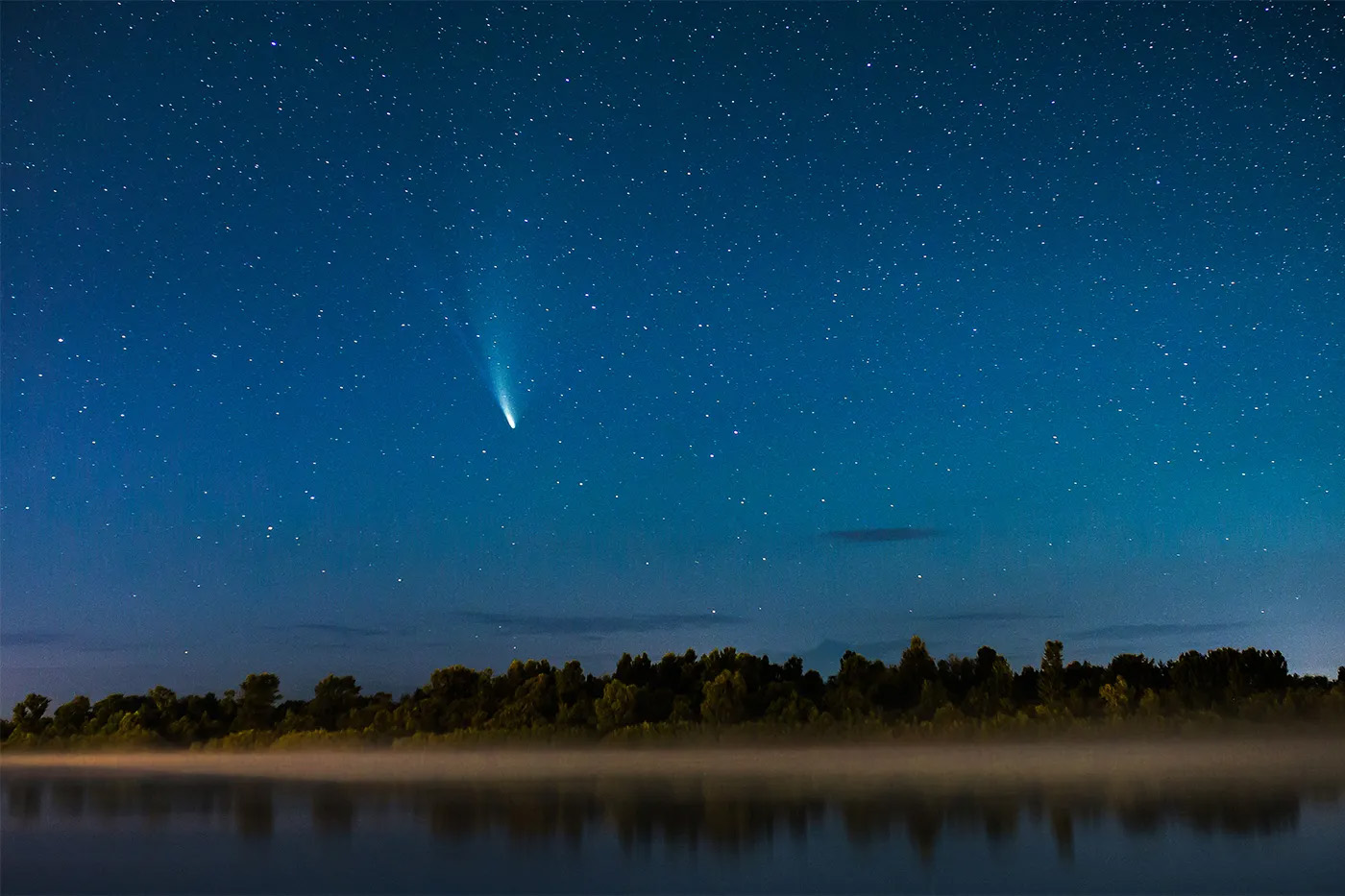
Last year, an interstellar traveler entered our Solar System. Some speculated that it was an alien spacecraft, but it turned out to be a comet, 3I/Atlas, and provoked interest from astronomers and astrophysicists eager for insights into galaxies far, far away.
Detailed observations from the National Aeronautics and Space Administration (NASA) shot down the alien spacecraft idea, but recent NASA analysis holds clues about the comet’s ancient and, literally, alien origins.
With its powerful James Webb Space Telescope (JWST), NASA was able to capture detailed data on the interstellar traveler, including its chemical composition. The findings are akin to “alien chemistry” for an object that was likely formed 10 to 12 billion years ago in a still mysterious period known as the universe’s “cosmic noon,” said Jacqueline McCleary, an assistant professor of physics at Northeastern University.
“This clearly did not originate within our cosmic gene pool,” McCleary said. “This is sort of like gene sequencing a rose and then finding a fern. The building blocks are the same, but a lot has changed in the last few billion years to go from fern to rose.”
Read more at Northeastern Global News
Photo by Getty Images