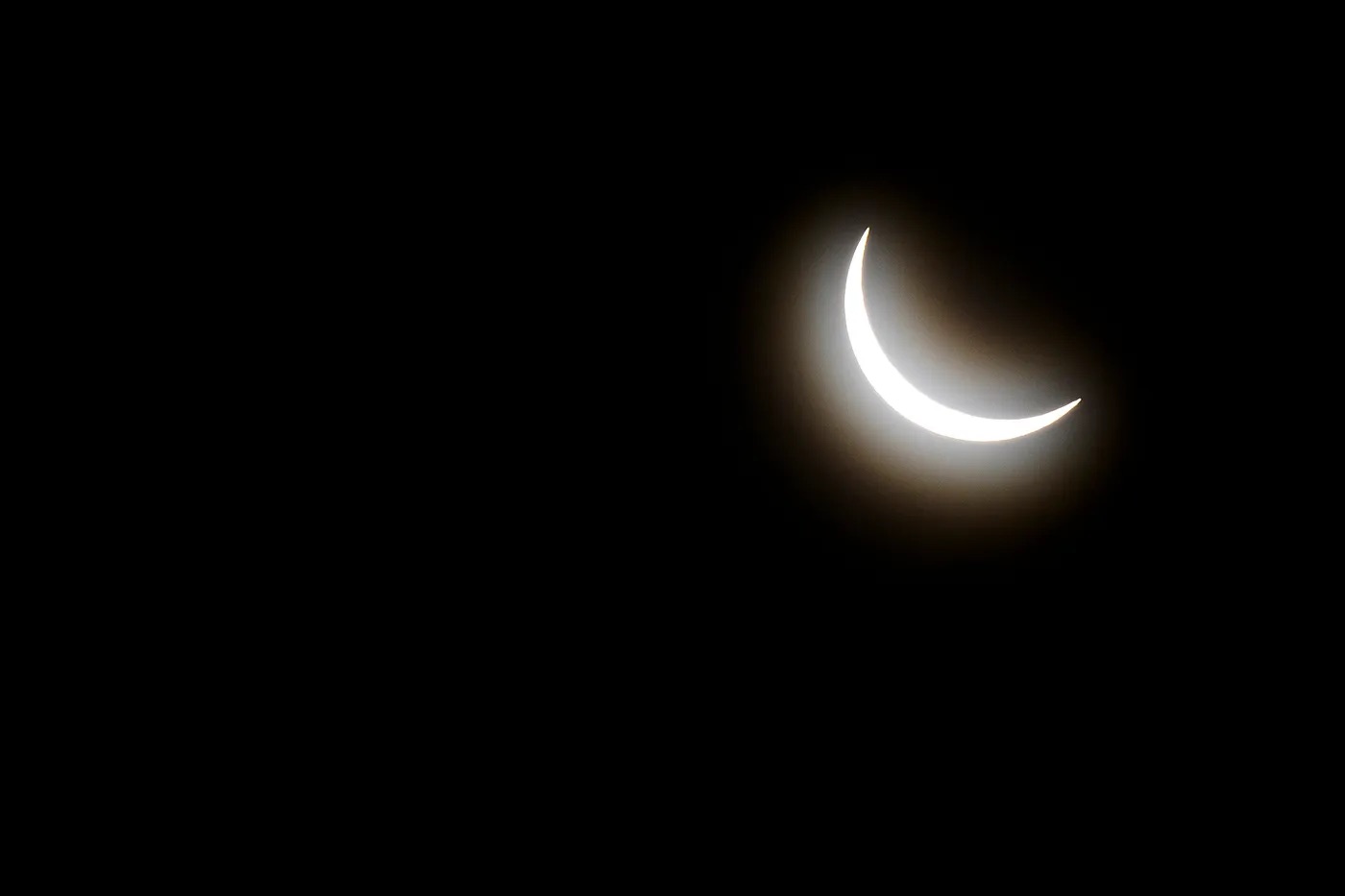
Darkness will fall for the briefest of moments before the sun sets this week in parts of Asia, North America and Europe. That’s because the moon will pass between the sun and Earth and create a total solar eclipse on Wednesday, Aug. 12.
During a solar eclipse, the moon partially or fully blocks light from the sun. When the light is fully blocked, a shadow is cast on parts of Earth on what’s called the path of totality. A partial eclipse, where the moon blocks part of the sun, can be viewed at varying degrees on either side of this path.
“Eclipses provide us with a fascinating opportunity to visualize where we are in the solar system,” said Jonathan Blazek, an associate professor in the physics department at Northeastern University. “The distances and sizes involved can be difficult to imagine, even for professional astrophysicists. Seeing one object pass directly in front of another gives us a unique, and beautiful, perspective.”
Most of the solar eclipse event is a partial eclipse. In areas that will see the total solar eclipse, darkness will last between one to two minutes, Blazek said.
The path of totality on Wednesday will twist around the North Pole, reaching remote northern Russia, Greenland, Iceland, Spain and a small sliver of Portugal.
Here’s what else you should know about the upcoming solar eclipse.
Read more at Northeastern Global News
Photo by Matthew Modoono/Northeastern University