Over the past two decades, the Gulf of Maine has become a popular landing spot for invasive species from across the world, says Geoffrey Trussell, an evolutionary biologist and professor at Northeastern University’s Marine Science Center in Nahant, Massachusetts.
“Lots of invasive species have arrived on our shores, mostly through ship ballast,” he explains. “So you have this confluence of significant environmental changes.”
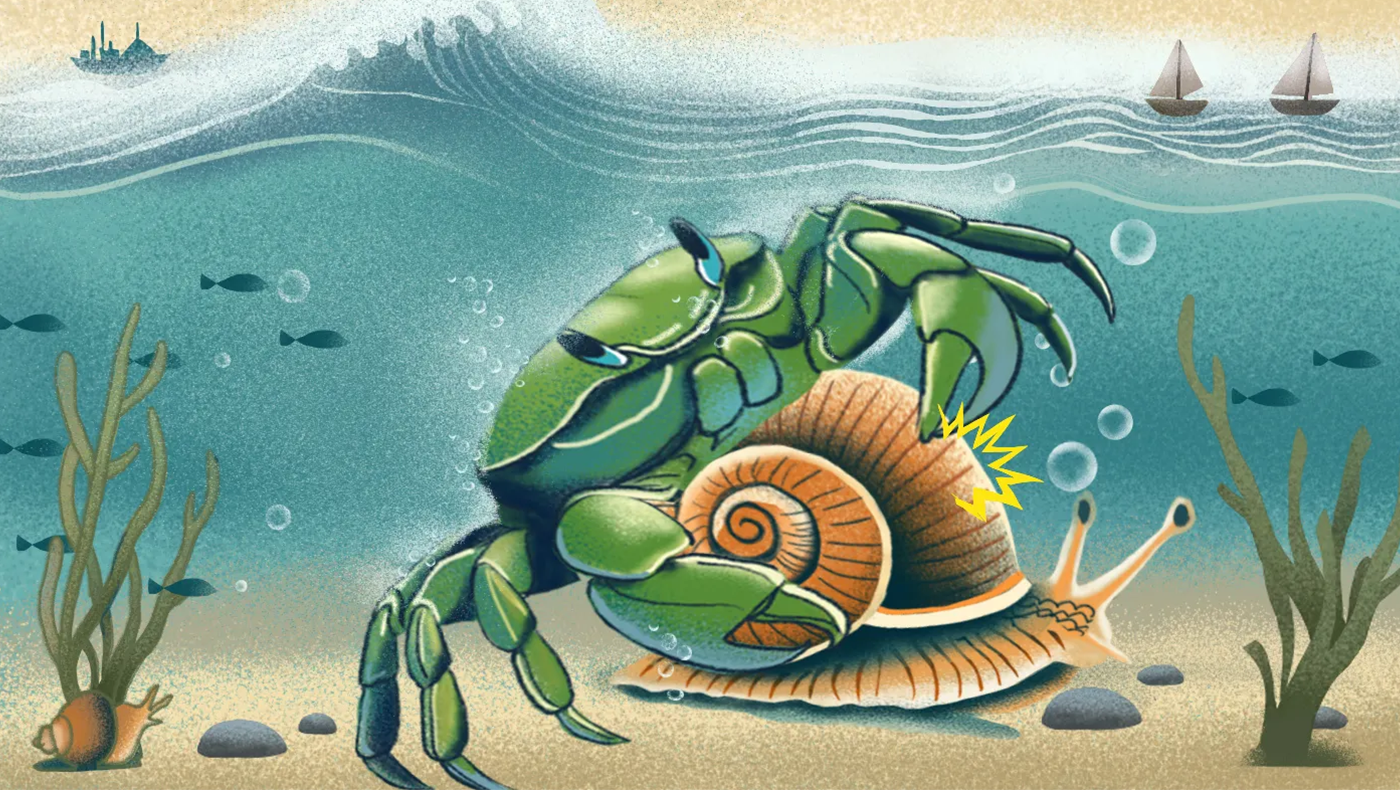
Trussell has witnessed those changes on the ground — very, very low ground. Starting when he was a Ph.D. student in the 1990s, he has monitored the evolution of two common species of sea snails living off Maine’s coast, tracking how they have responded to changes in that environment and the resulting influx of predators. Among the most successful of these are predatory green crabs — small, brightly colored crustaceans that have surged north from the mid-Atlantic coast over the past few decades and love to feast on tidal snails.
In a recent paper published in the academic journal Science Advances, Trussell and collaborator James Corbett document how the snails (Nucella lapillus and Littorina obtusata) have evolved in response. In brief: they’ve grown thicker shells.
Read more from Northeastern Global News.
Illustration by Renee Zhang/Northeastern University