Grants
Society significantly benefits from scientific research, but it wouldn’t be possible without generous contributions from public and private sources.
This page is a testament to that support. With it, Northeastern’s College of Science has cultivated a dynamic landscape of research activity. Through a culture that emphasizes entrepreneurship, our exceptional faculty, staff, and student researchers are able to maximize the impact of their work.
The grants listed below are a preview of the science and scientists of tomorrow, who probe single cells, the outer limit of particle physics, and everything in between.
Showing all results
-
03/08/2023
Loretta Fernandez
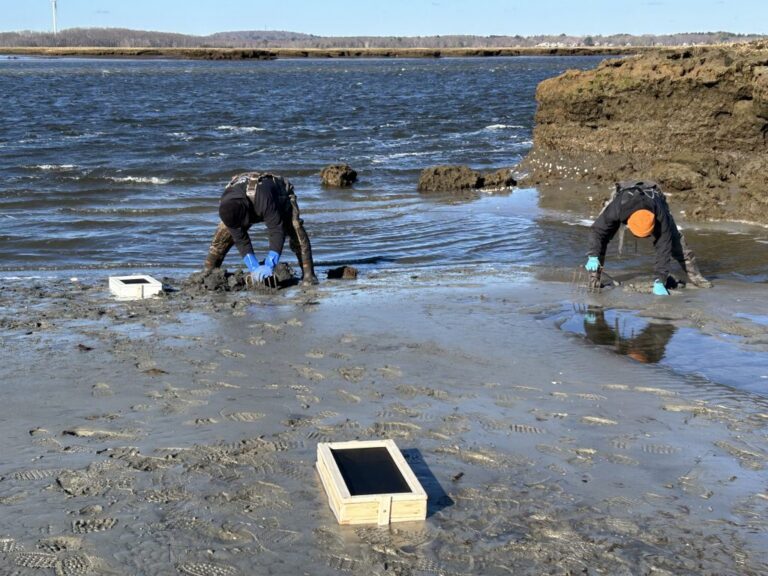
Sponsor: NOAADetermining how aquaculture grow-out methods can reduce the negative effects of parasites and micropollutants on farmed oysters We will be collaborating with local oyster farmers to investigate how growing methods (on the bottom vs. Floating) and water quality affect the prevalence and intensity of common oyster parasites. The knowledge developed through this work will…Read More -
03/03/2023
Sijia Dong and Hannah Sayre
Sponsor: DOEBioinspired Light-Escalated Chemistry (BioLEC) The mission of the BioLEC Energy Frontier Research Center (EFRC) is to combine light harvesting and advances in solar photochemistry to enable more powerful editing, building, and transforming of abundant materials to produce energy-rich feedstock chemicals. As part of the BioLEC EFRC, we will develop new supercharged light-powered catalysts and reactions…Read More -
03/03/2023
Bryan Spring
Sponsor: NIHDisease-homing light delivery by engineering bioluminescent immune cells for whole body precision photomedicine Photomedicine avoids traditional side effects of systemic chemotherapy, yet effective outcomes are dependent on direct irradiation from an external light source that limits the scope and the types of cancers that may be treated. This proposal develops a precision photomedicine platform that…Read More -
03/03/2023
Eddie Geisinger
Sponsor: NIHRepurposing Gram-positive Antibiotics for Gram-Negative Bacteria using Antibiotic Adjuvants The multidrug-resistant (MDR) sepsis pathogen Acinetobacter baumanni presents an enormous ongoing challenge to public health. Current treatment options for infections with these bacteria are extremely limited. Our research examines a class of small molecules called antibiotic adjuvants that greatly boost the activity of several existing antibiotics…Read More -
01/26/2023
Carolyn Lee-Parsons
Sponsor: NSFPlantSynBio: A Novel CRISPR SynBio Tool for Investigating and Reprogramming the Regulation of Alkaloid Biosynthesis in Catharanthus roseus Plants produce a white array of valuable, biologically active natural products we use as medicines. This grant will enable engineering for enhanced drug production from the medical plant, C. roseus.Read More -
01/20/2023
Rebecca Sherbo
Sponsor: Catalyst Grant, Schmidt Science FellowsIdentifying factors that promote soft coral resilience in climate change-induced This work, in collaboration with a biophysicist, will explore the resilience of soft corals to rising ocean temperatures by understanding two main adaptations: the coral microbiota, and the morphology and growth patterns.Read More -
01/18/2023
Rebecca Shansky
Sponsor: NIHSex-dependent pain processing circuitry in classical Pavlovian fear conditioning Traumatic experiences create powerful memories by linking information about the trauma itself with environmental cues associated with the event. Our lab has found evidence that males and females may form these memories using different brain regions, and this grant will allow us to probe this question more…Read More -
01/11/2023
Justin Reis
Sponsor: NOAAPolymorph mineralogy & fraction of calcium carbonate (CaCO3) sediments across the western North Atlantic shelf (Gulf of Maine to Chesapeake Bay) Prof. Justin Ries was funded to collect and analyze sediments from the western Atlantic shelf (Maine to Maryland) as part NOAA’s third East Coast Ocean Acidification (ECOA-3) cruise aboard the NOAAS Ronald H. Brown…Read More -
11/21/2022
Laurel Gabard-Durnam
Sponsor: Gates FoundationThe goals of this award are first to design and validate a scalable, affordable hardware-software package that reliably measures brain function via EEG in babies over the first two years of life. Second, in multi-country studies using this EEG system, we will establish which measures of early brain function track healthy developmental changes associated with…Read More -
11/02/2022
Sam Munoz
Sponsor: US GeoRiverine flooding is a perennial hazard in the heavily populated Northeastern United States, and improving near- and long-term forecasts of flooding in this region is of critical importance for regional water resource management, infrastructure planning, and fisheries. In this project, we will harness advances in climate reanalysis and modeling to (i) identify the ocean-atmosphere patterns…Read More -
10/05/2022
Gabor Lippner
Sponsor: Simons FoundationGraph theory – the mathematical study of networks has originally developed as a part of discrete mathematics and combinatorics. This has changed significantly in the past 20 years following discoveries of connections to Linear Algebra and later to Geometry and even to Real Analysis. The goal of this project is to find new applications to,…Read More -
10/05/2022
Michele Di Pierro
Sponsor: NIHThe aim of the project is to gain mechanistic understanding of the relationships among non-coding genomic variation, phenotype, and disease. To achieve this aim, researchers will combine data from DNA-DNA proximity ligation assays and multiple genome alignments to extract coevolutionary information about DNA elements and to infer the network of functional interactions among them.Read More
News
-
Research
Quantum computing research earns professor prestigious Cottrell Scholar Award
Yizhi You, an assistant physics professor, was named a Cottrell Scholar, which is bestowed on promising early-career academics studying chemistry, physics or astronomy. -
News
Mass Spectrometry Facility awarded grant to advance single-cell proteomics research
Northeastern University’s Mass Spectrometry Facility has been awarded a $2.2 million research infrastructure grant from the Massachusetts Life Sciences Center (MLSC) to build a cutting-edge core supporting single-cell proteomics research. The award, through the Center’s Research Infrastructure program, will establish a fully integrated pipeline that enables researchers to measure proteins at single-cell resolution, filling a… -
Research
European Physical Society honors professor’s groundbreaking contributions to the physics of complex networks
Northeastern professor Alessandro Vespignani earns the European Physical Society’s top award for helping to lay the foundation for physics models of contagion. -
News
Twelve Northeastern scholars make ‘Highly Cited Researchers’ list
The faculty members were included in this year’s “Highly Cited Researchers” list, an annual compilation by the data analytics company Clarivate that recognizes scholars who rank among the top 1% of their field. -
News
Northeastern University professor honored with prestigious American Psychological Association award
Laurel Gabard-Durnam, whose work focuses on brain plasticity and creating real-world tools, will receive the Boyd McCandless Award in August, 2026. -
News
From coastal resilience to streamlining product development, Northeastern researchers are the state’s AI innovators
Northeastern University professor Jim Chen is one of the winners of the Massachusetts AI Hub’s AI Models Innovation Challenge. -
News
Three Seas student wins AAUS Award
Congratulations to Zoe Salyapongse, Three Seas Program Cohort 45, on being awarded the American Academy of Underwater Sciences (AAUS) research award! -
News
Northeastern physicists honored with Breakthrough Prize in Fundamental Physics for unveiling secrets of the universe
Several Northeastern physics professor, PhD student, and researchers, where recognized in the 2025 Breakthrough Prize in Fundamental Physics for their research into the fundamental nature of matter at CERN’s Large Hadron Collider. -
News
How a Northeastern astrophysicist fills in the blanks of the universe
Jonathan Blazek, assistant professor of physics and astrophysicist, is developing new ways to map and predict galaxies.