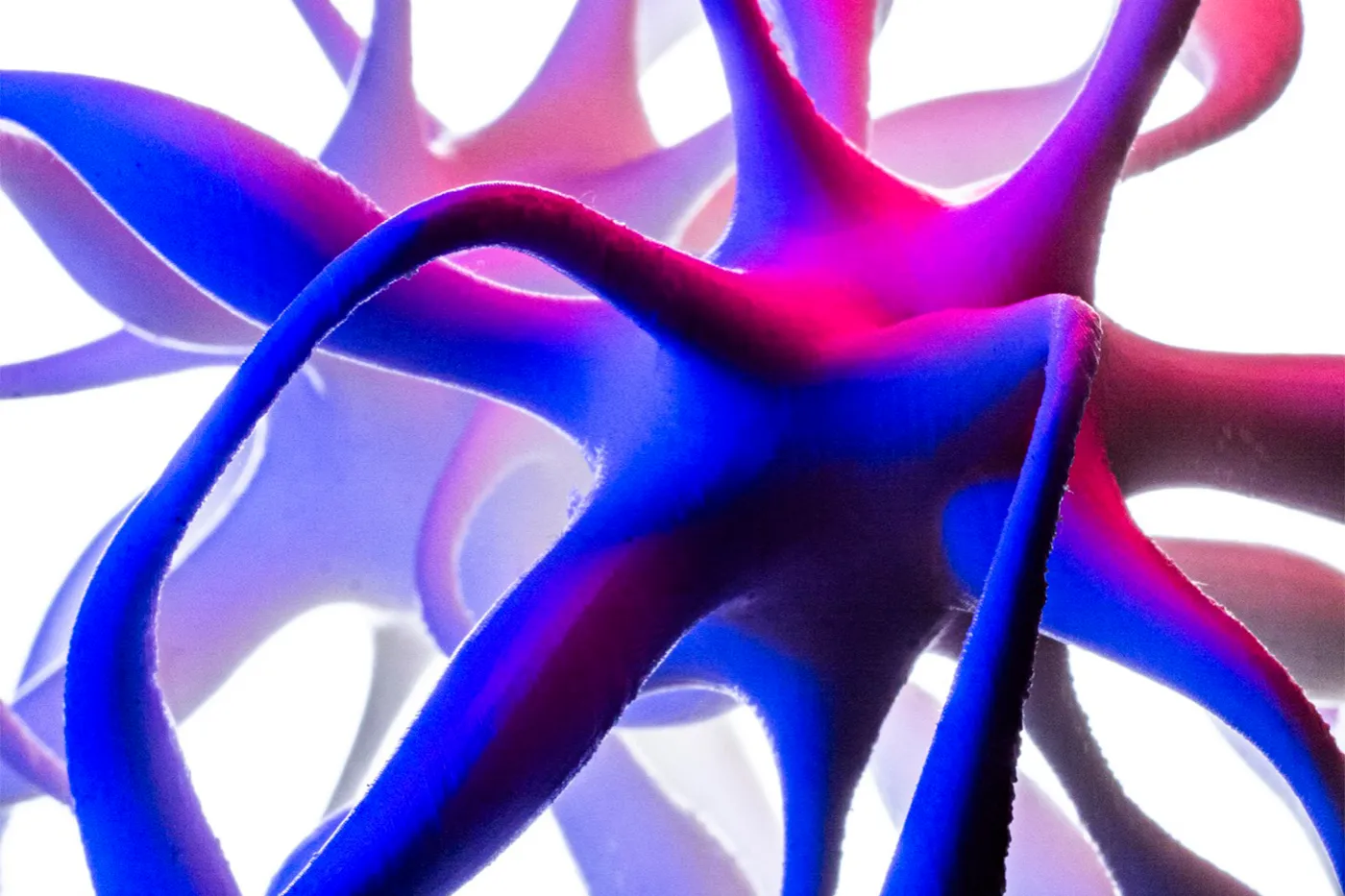
How efficient is your brain? Since the 1940s, scientists have hypothesized that the connections between neurons took the shortest route between two points, a straight line from neuron A to neuron B. But recent observational data have largely contradicted this hypothesis.
When a model scales up from a few points on a two-dimensional surface to thousands of them in three-dimensional space, all of them interacting and connecting in uncertain ways, the most efficient routes become complex mathematical problems.
In tackling this problem, new research from the Network Science Institute at Northeastern University made a surprising discovery: Some of the same mathematics used to describe string theory, which attempts to make sense of the quantum realm, could be used to solve the question of why neurons branch and connect as they do.
Read more at Northeastern Global News
Photo by Peter Pukus