What inspired you to pursue your current field of study/research?
My inspiration to pursue data science and behavioral science stemmed from lived experiences growing up in Chicago, IL, where I witnessed firsthand the language barrier and information gap between patients and their healthcare providers. At just 9 years old, I found myself becoming my mother’s medical translator and asking, “If more healthcare providers spoke more than one language, would patients feel more comfortable seeking treatment?” That question never left me.
I also noticed how data visualizations made a real difference — a single translated word on a chart could communicate what a whole paragraph could not. Those early observations sparked my passion for the critical role data plays in medicine, from analyzing complex datasets to advancing precision medicine and improving patient outcomes.
My research journey began during high school through UIC’s Medicine Academy Apprentice Program, where a coordinator encouraged me to apply to the Cancer Health Equity Summer Scholars (CHESS) internship — a program I almost didn’t apply to because I doubted my own qualifications. Sponsored by the University of Illinois Cancer Center, I researched the characterization of extracellular vesicles from brain metastatic breast cancer cells.
The following summer, under the American Cancer Society’s sponsorship, I investigated liquid biopsy in glioblastoma through kit optimization using miRNA, exosomal RNA, and exosomal DNA. Since then, I’ve continued building on that foundation through research at Northeastern University, Massachusetts General Hospital, Harvard Medical School, and most recently, the Center for Genomic Medicine.
How has entrepreneurship impacted your view on science and/or your current research/study area?
Entrepreneurship has taught me to see science not just as a pursuit of knowledge, but as a tool for building solutions. Growing up navigating healthcare systems as my mother’s translator, I always sensed there was a gap — but entrepreneurship gave me the framework to think about how to actually close it. It pushed me to ask not only “what does the data show?” but “who is this for, and how do we make it reach them?”
Leading U-F1RST as president deepened this perspective. Rebuilding an organization from the ground up — identifying a need, creating programming, sustaining a community — mirrors the entrepreneurial process in many ways. It showed me that the same mindset that drives innovation in research, taking a chance, iterating, and centering the people you serve, is what creates lasting impact both in the lab and beyond it. Now when I approach my research, I think about accessibility, communication, and real-world application in ways I didn’t before.
What does winning the Science Connects to Innovation Scholarship mean to you?
Winning the Science Connects to Innovation Scholarship is truly meaningful to me. As a first-generation Latina pursuing a career in medicine and research, this award is a reminder that I have a village behind me — supporting my growth, my work, and my ideas. Because it truly does take a village to get someone to the finish line, and this scholarship is proof of that.
What do you plan to use the Science Connects to Innovation Scholarship for?
I plan to use the Science Connects to Innovation Scholarship to support activities and opportunities outside the classroom that fuel my growth as a researcher and future physician. So far, it has helped me continue part-time work at my previous co-op and register for conferences that expand my professional network.
In March, I’ll be attending Harvard’s World Pre-Health Conference, where I’ll be presenting the poster I showcased at the Alzheimer’s Association International Conference
in July 2025 and was shortlisted for the Student and Postdoc Poster Award — sharing my work with pre-health students from across the country.
Where do you see your entrepreneurship ideas going in the next few years?
In the next few years, I see my entrepreneurship ideas naturally weaving into everything I’m already building — my research, my advocacy, and my path toward medicine. I believe that no idea is too small. One small suggestion, one honest observation, one moment of courage to speak up can become the foundation that the next generation builds on. I want to keep planting those seeds.
What advice would you give science students interested in entrepreneurship?
The best advice I’ve received — from mentors, doctors, and researchers alike — is simply to take that chance. As a first-generation student, I’ve talked myself out of applying to programs and scholarships simply because I felt unqualified, even when I met every requirement. Every single time I pushed past that fear and applied anyway, it led to an opportunity that changed my trajectory.
So to anyone reading this: take that chance. You never know what’s waiting on the other side.
What is something that you are most proud of?
Being a first-gen student means experiencing a lot of firsts — my first lab class, my first coding course, my first professional headshot. Each one felt significant.
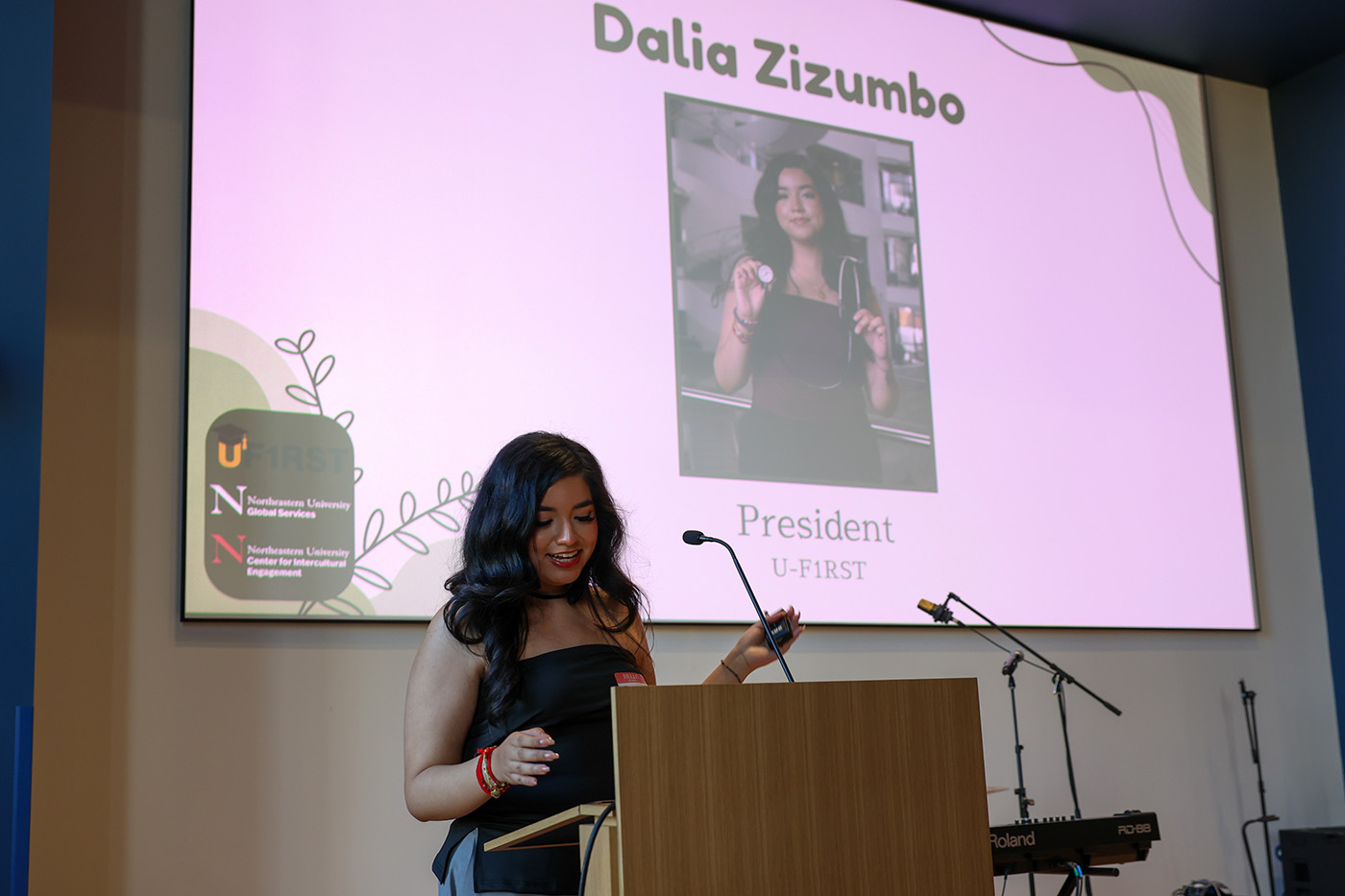
But what I’m most proud of is the community we’ve built through U-F1RST, the student-led organization I lead as president, dedicated to closing the information and support gap for first-generation and low-income students.
As I shared in my 2025 Convocation speech, “I discovered I wasn’t alone in navigating college with my unique background. Meeting other first-gen students showed me that our experiences, while challenging, are also sources of strength.” Holding onto that truth — and passing it forward — is what drives everything we do, from our semesterly co-op clothing drives and annual first-gen brunch to our yearly student academic symposium.
I’m proud of what we’ve built, and even more proud of the students who walk through the door feeling a little less alone because of it.