COS News
Research
“The basic premise is that AI can help us do better physics, and something that is less expected is that physics can also help us understand AI better,” said Northeastern professor James Halverson.
AI and physics have more in common than you might think.
News
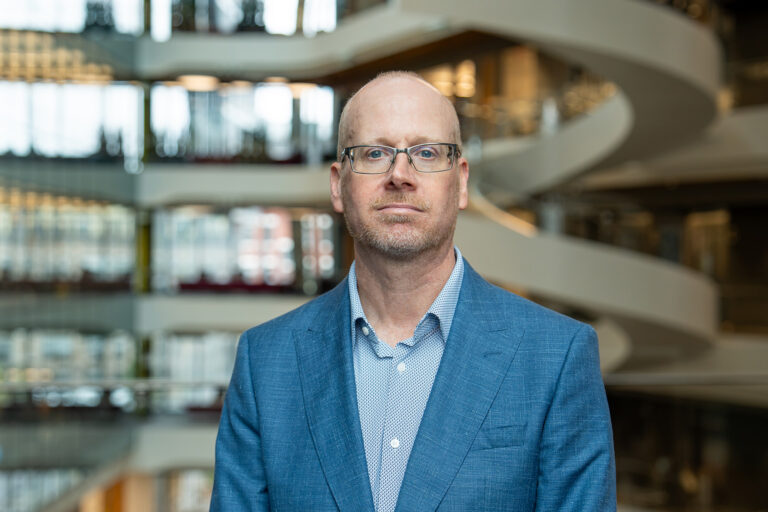
Mark Williams, Professor and Chair of the Department of Physics, will assume the role of Dean of the College of Science, effective July 1, 2026.
Mark C. Williams named Dean of the College of Science

This Northeastern physicist is revolutionizing astronomy with unprecedented dark matter mapping through space observatory in Chile
A new astronomical observatory nearing completion atop a desert mountain in northern Chile will reveal the workings of the universe as never before. It might even revolutionize our understanding of the mysterious forces shaping the cosmos, such as dark energy, says Northeastern assistant physics professor Jonathan Blazek. With a telescope as wide as a tennis...
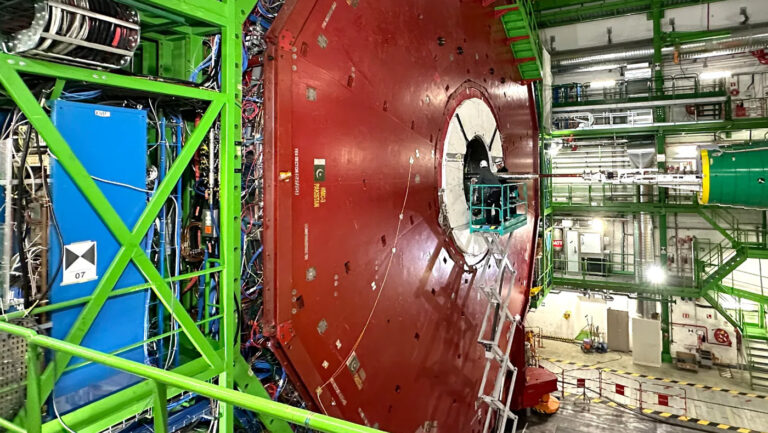
Meet the Northeastern co-op helping to upgrade the world’s largest particle accelerator at the European Organization for Nuclear Research
For Christian Bernier, it started with videos he saw as a kid on popular YouTube channels like Minute Physics. Bernier has always been interested in science, so he found topics around the fundamentals and building blocks of the world to be particularly fascinating. He quickly developed an “insatiable desire to know more about the universe,...

Desert locusts’ jaws sharpen themselves, Northeastern materials scientist discovers
Sharks lose teeth all their lives, replacing them in a kind of endless rotating Rolodex, while humans, of course, get only our two sets. Beavers’ teeth, notoriously, grow all their lives and have to be worn down to prevent injury. New research has now placed another animal into the self-sharpening set, Schistocerca gregaria, the desert...
Using a Novel Balloon-Borne Technology to Probe Deeper into our Dark Universe
NASA has awarded Northeastern and partners a prestigious grant to launch a particle detector into earth’s upper atmosphere. How can we better understand vital questions about the unseeable dark matter that seems to constitute much of the vast universe around us? And how can we capture the faintest yet most information-rich signals from distant astrophysical...
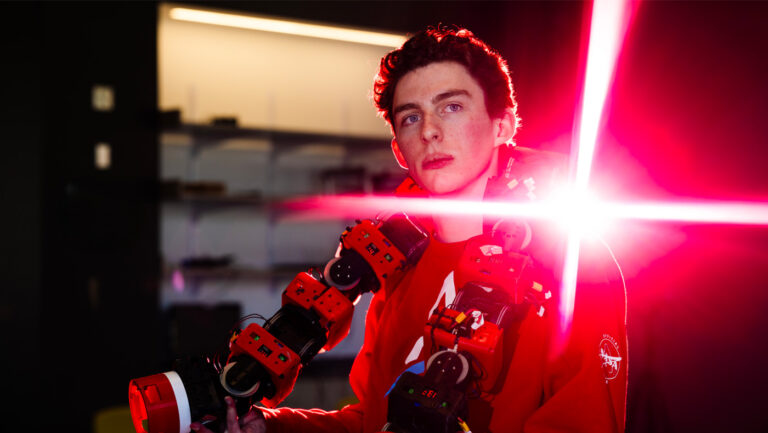
Can robots be used to extract ice on the moon? This NASA research fellow from Northeastern wants to find out
Henry Noyes’ wiring work can be seen all over COBRA, Northeastern University’s award-winning serpentine robot designed to tumble down the deep craters on the moon. As the electrical lead of the Crater Observing Bio-inspired Rolling Articulator project, Noyes designed the machine’s power system, allowing each of its individual modules to function in harmony. Noyes, who...
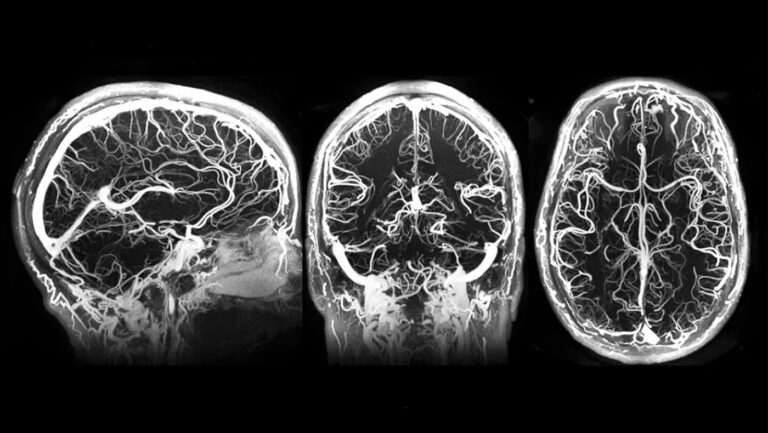
Meet the Innovators: Northeastern grads promise early detection of diseases with breakthrough MRI technology
Codi Gharagouzloo, a physicist and bioengineer, enrolled in the Ph.D. program at Northeastern University in 2011, dreaming of curing cancer. “I originally came in with this sort of magic bullet idea,” he says. “I thought nanoparticles were just going to be the cure to cancer.” In the mid-2000s, nanoparticles, a class of tiny materials that...
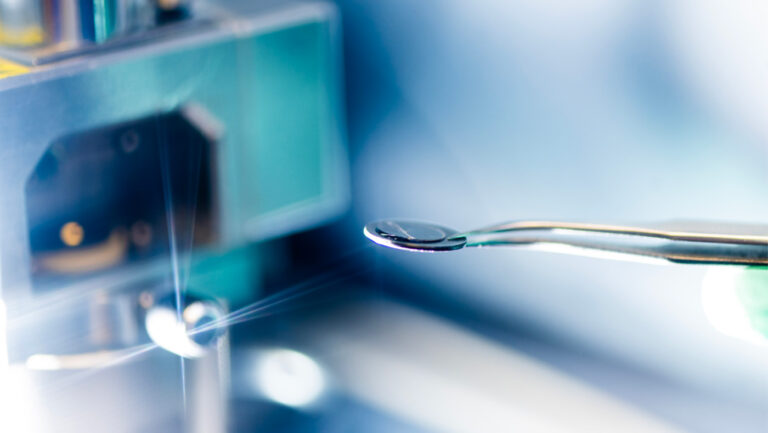
Northeastern research on HIV infection could lead to better drugs to treat the virus
It has been more than 40 years since the beginning of the HIV/AIDS epidemic and scientists still don’t fully understand how HIV enters and replicates in human cells, which has hindered the development of treatments. New research by a team of physicists led by Northeastern University professor Mark Williams is working on a solution. There is no...
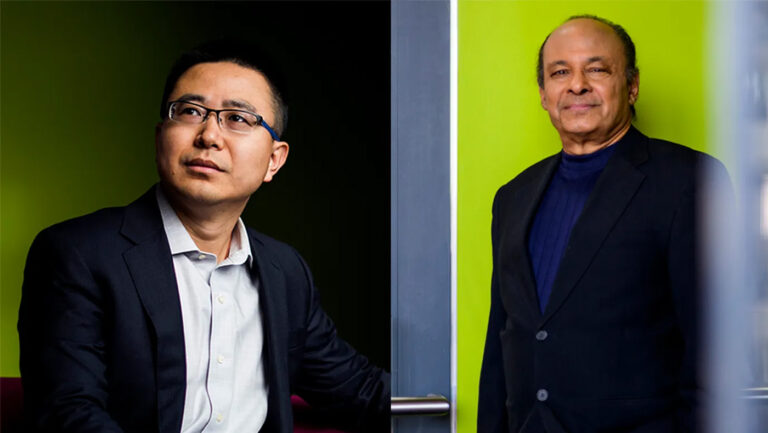
From facial recognition to nanomedicines, these Northeastern inventors are transforming health care and technology
A new method of measuring brain signals that can be used to diagnose eye conditions such as macular degeneration, glaucoma and optic neuritis. Nano-medications that target cancerous tumors to reduce negative side effects that come with chemotherapy. AR technologies that can let users try on different makeup brands virtually from home. These are a few...

Unveiling the Potential of Bismuth Ferrite in Antiferromagnetic Spintronics – A Q&A with Professor Paul Stevenson
In their recent publication, physics assistant professor, Paul Stevenson, and his collaborative team from Northeastern University, Brown University, Rice University, and University of California Berkeley reveal groundbreaking advancements in utilizing isolated spins in solids. Their work, enabled by the Quantum Materials and Sensing Institute, pioneers ultrasensitive nanoscale sensors and quantum communication technologies. Through interdisciplinary efforts,...

The untold story of how two Northeastern professors analyzed moon rocks for NASA a half-century ago
The rocks were billions of years old. But they were new to the Earth. They were sent by NASA in 1972 via special delivery to Robert Lowndes and Clive Perry, physics professors at Northeastern University, who opened the boxes in their secured labs in the basement of Dana Hall. “It was very exciting,” Lowndes says....
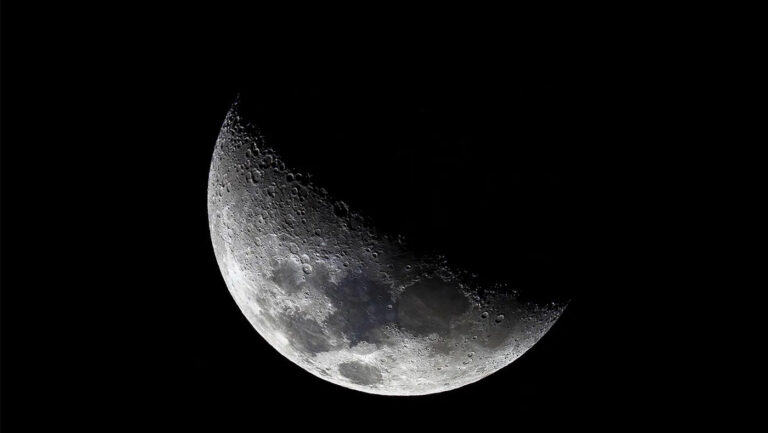
What time is it on the moon? We may soon know, thanks to NASA project
From sundials and water clocks to modern atomic timekeeping, methods for telling time on Earth — to mark the divide between night and day, month to year, etc. — have evolved over thousands of years. Now, scientists are bringing their technological knowhow to the moon in order to establish time standards there and elsewhere in...

New models of Big Bang by Northeastern physicists show that visible universe and invisible dark matter co-evolved
Physicists have long theorized that our universe may not be limited to what we can see. By observing gravitational forces on other galaxies, they’ve hypothesized the existence of “dark matter,” which would be invisible to conventional forms of observation. Pran Nath, the Matthews Distinguished University Professor of physics at Northeastern University, says that “95% of...