There are lots of threads swirling about, lots to consider. Most important is your health and wellness, so please take care of that above all else. At Northeastern University, we are always reinventing, and trying things out. It’s exciting and disruptive. It’s why I joined the university, and why Northeastern is leading innovation in higher education. In the Northeastern University College of Science, we are committed to supporting each member and to communicating changes to you. Our country is also changing, and there are multiple threads of disruption and reorganization. Let’s remember our pandemic tagline, still relevant: be kind, be calm, be creative. We will deal with changes together.
The sense of threads in our lives reminded me of the time my young daughters ran with the concept and tied up the house. One morning, their parents found that multiple balls of yarn had rendered the stairs, living room and kitchen impassable. After the surprise, annoyance, and amusement in response to this novel activity, I wondered briefly whether we could rewind the yarn by following the threads and undoing the tangled meshwork. But in fact, scissors were the only solution, cutting through the tangle and freeing passage again.
We follow threads all the time, and people are good at this – in TV series, video games, in following events in the life of a friend. Somehow, though, when we consider our students, and how we educate, something is different, and difficult. We tend to teach in chunks – modules or lectures or sub-topics – and indeed we market educational chunks – badges or certificates. Students find it easiest to become competent in chunks often with the query ‘Is it on the exam?’ But the value of a course is not the individual pieces, it’s understanding the relationship between the sub-topics, and students can be helped or made lazy by new Gen-AI tools. (See the “AI in Higher Education and Research Forum” advertised below).
Conversancy with threads of a topic is empowering for every student in every subject, and I consider meeting the ‘challenge of the thread’ as critical in higher education. For example, in Molecular Biology – understanding each of the molecules and processes underlying cellular reproduction and communication is useful. However, putting it all together is where the deep value lies – how does one process impact another, how do processes connect over variable time scales to drive the lives of cells and organs? Holding the thread is crucial to understanding what molecules may form the basis of new medicines, what side effects can be predicted, and how cells can be used to heal illness and damaged organs. AI approaches have been part of molecular biology for a long time, and Gen-AI can help students understand some of the connections. But to empower a student with problem-solving skills that sets up each for bright next steps, the student needs to understand the thread at their own level, with their own mind.
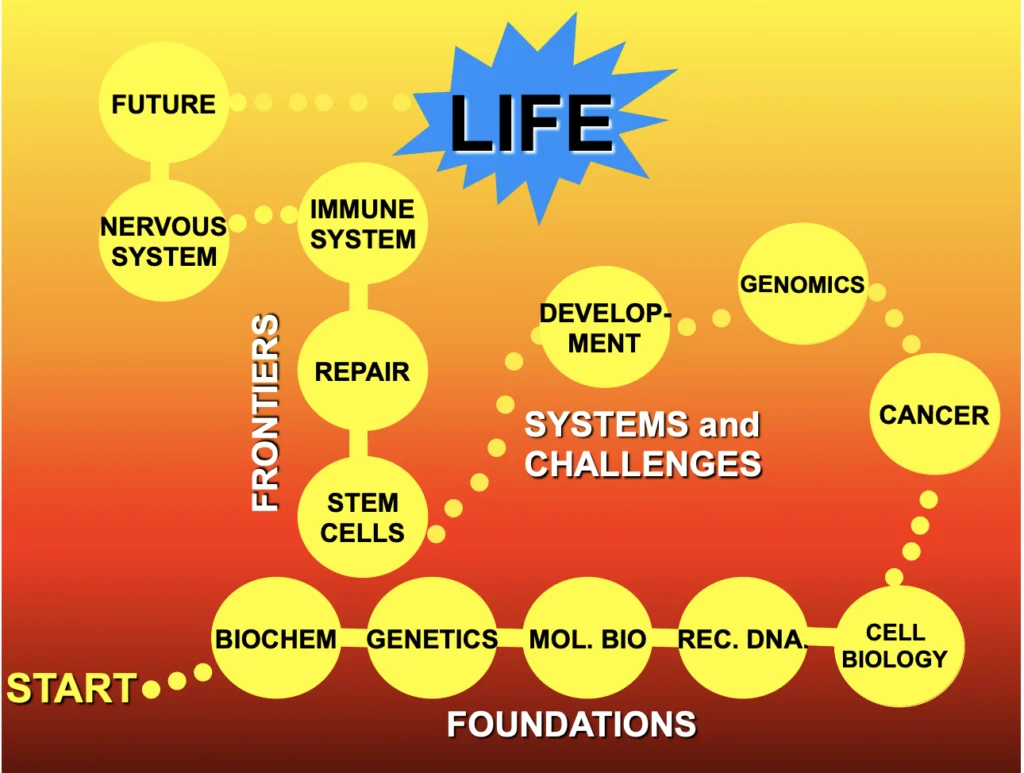
For eighteen years I taught Introductory Biology, some with Associate Teaching Professor Diviya Ray (Biology). The course was built as a ‘gameboard of life’ and students followed the thread of topics, that were linked and re-used. Students re-applied their knowledge of Biochemistry in the Neurobiology module, Genetics was re-used in the Cancer module, Molecular Biology in the Development module. The students found this challenging but commented that the approach helped them understand the awesome complexity of life. In this way students both followed the thread and cut through it to appreciate the connections across all of life.
On this busy Friday, please remember that We are a Diverse College where Everyone Belongs. I enormously appreciate your work building the Good Power of Science. Thank you.