Pran and Shashi Nath Distinguished Lecture: Dr. John Martinis, UC Santa Barbara and Qolab
Doors open at 2:15 p.m.
Prehistoric quantum bits: Experiments testing the fundamental physics of superconducting quantum devices
Quantum mechanics was developed to describe the physics of the small, for fundamental particles, atoms and molecules. But does it still work for macroscopic systems? My PhD thesis experiment in 1985 tested this idea, showing the macroscopic current and voltages in a 1 cm chip obey the quantum phenomena of tunneling and energy-level quantization, proving that a superconducting circuit can behave as a single ‘artificial atom.’
Over the last four decades, many physicists around the world have continued research on quantum devices. The field has evolved from fundamental tests into a high-stakes effort to build quantum bits and a quantum computer. At Google, our ‘quantum supremacy’ experiment was the culmination of this system-level optimization, proving that a processor could outpace classical supercomputers by maintaining high-fidelity control over a huge computational (Hilbert) space. Now, at my startup Qolab, we are leveraging 300mm semiconductor fabrication to achieve the extreme uniformity and yield necessary to build a useful general-purpose quantum computer.
Lecture begins at 3:00 p.m. with a reception to follow. This event is complimentary but registration is required.
Speakers
-
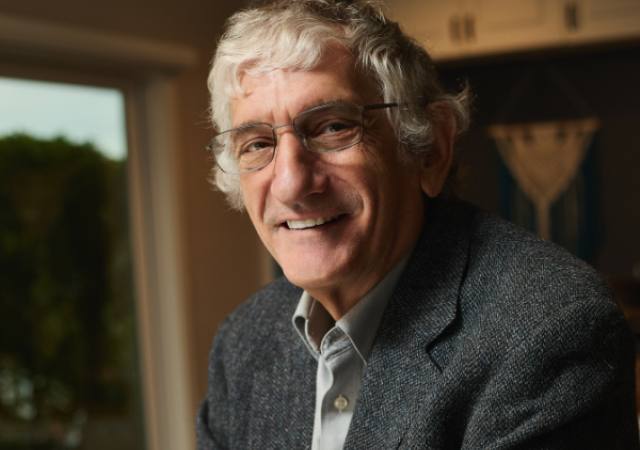
Professor, Physics
UC Santa BarbaraJohn Martinis is a distinguished physicist and 2025 Nobel Laureate in Physics, renowned for his pioneering contributions to superconducting quantum computing. His research has been central to developing high-fidelity qubits and engineering the architectures needed for scalable quantum processors.