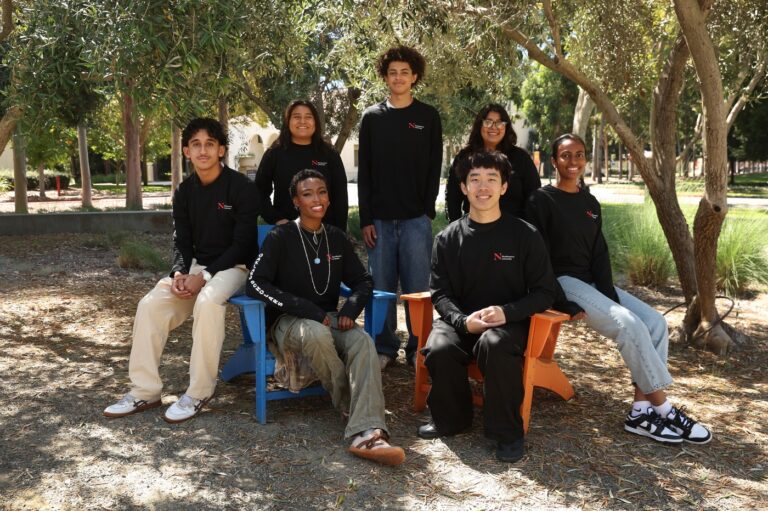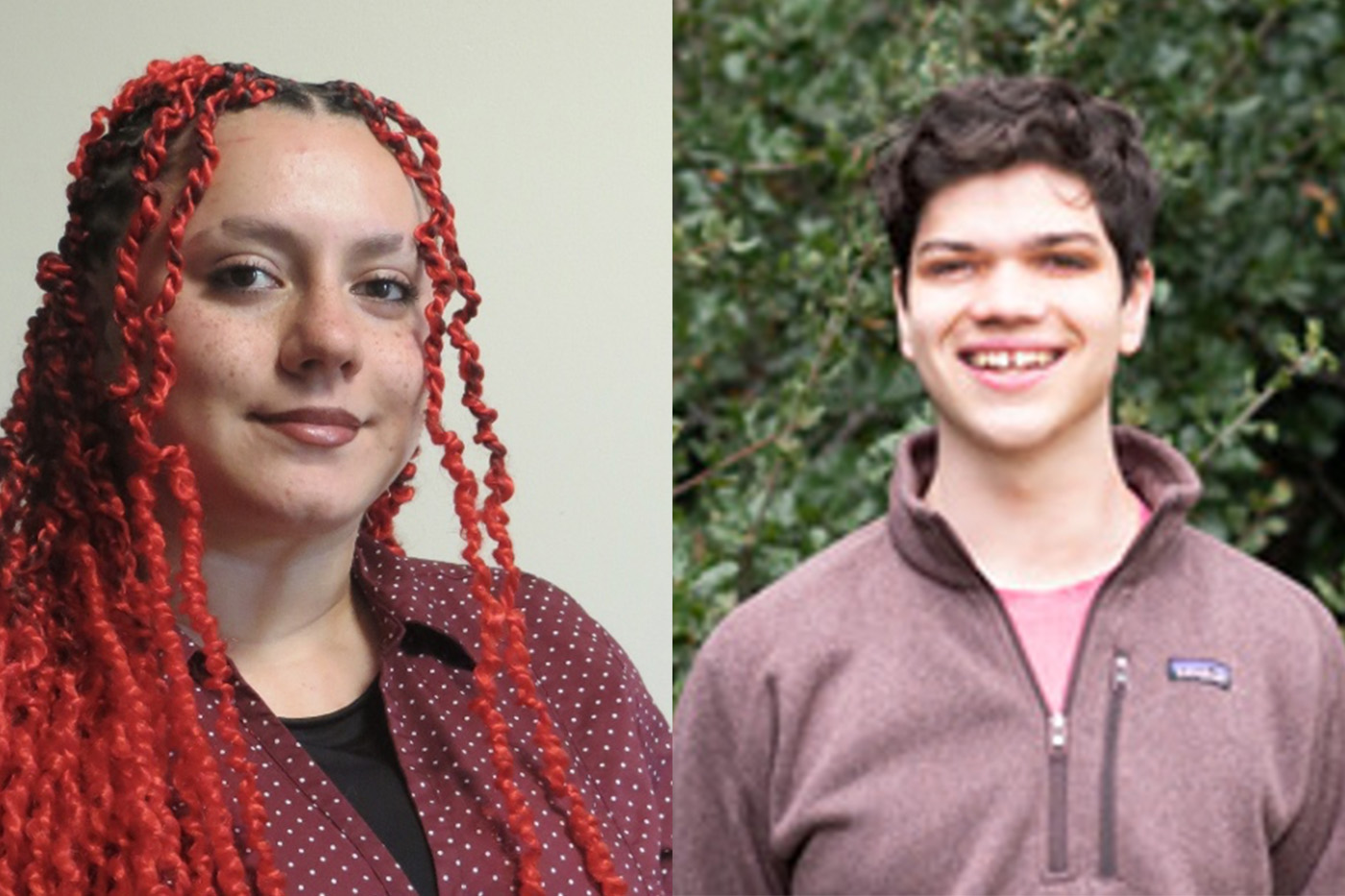
Two Northeastern undergraduate students have been selected as 2026 Beckman Scholars, joining a nationally recognized program that supports undergraduate students pursuing long-term, research-intensive experiences in STEM. This year’s scholars are Emily Baloche, mentored by Dr. Carla Mattos, and Simon Braun, mentored by Dr. Aron Stubbins.
The Beckman Scholars Program helps students deepen their laboratory research experience while preparing for graduate education and future careers in scientific research. At Northeastern, the program is led by Diego Alzate-Sanchez, assistant professor of chemistry and chemical biology, with Leila Deravi, associate professor of chemistry and chemical biology, serving as co-principal investigator.
Now in its second year at Northeastern, the program continues to strengthen undergraduate research opportunities through mentorship, collaborative scientific environments, and access to advanced research facilities.
Emily Baloche works in Dr. Carla Mattos’s lab, studying protein interactions connected to cellular signaling and regulation.

What excites you about being a Beckman Scholar?
I am excited to be a Beckman Scholar because now I have more support to continue working on my current project. I am so thankful for this opportunity and for the chance to contribute to the chemistry community in a meaningful way through my work.
I am also excited because, through the Beckman Scholars program, I will get to meet other wonderful young scientists and see the interesting research people are doing around the country!
What will you be working on during your time as a Beckman Scholar?
My project revolves around RalA, a membrane-bound small GTPase. RalA is shown to interact with Calmodulin (CaM), although the structural basis and regulatory mechanism of this complex remain unclear. This project aims to determine the crystal structure and biochemical properties of the RalA/CaM complex using both full-length and N-terminally truncated RalA constructs. In addition, post-translationally modified CaM is used to aid in stabilizing interactions within the RalA/CaM complex. Binding affinities between CaM and RalA variants are measured using isothermal titration calorimetry (ITC) to evaluate the role of the disordered N-terminal region in complex stability and function.
What are your long-term goals in chemistry?
After my time at Northeastern, I want to get a PhD in Protein Chemistry! I just want to learn as much chemistry as possible.
Simon Braun works in Dr. Aron Stubbins’s lab, researching the environmental impacts of microplastics in marine ecosystems.
What excites you about being a Beckman Scholar?
Being a Beckman Scholar excites me greatly in large part because it enables me to participate in long-term research with the support of the wonderful professor Dr. Stubbins. Having access to the excellent equipment in EXP, as well as guidance from Dr. Stubbins, both through resource access as well as idea review, will be vital to my success.
Additionally, I am excited by this opportunity to present my work and discover other Beckman Scholars’ work at symposiums held every year. I am looking forward to presenting the results I find in my work to other students and professors.
What will you be working on during your time as a Beckman Scholar?
During my time as a Beckman Scholar, I will be working on plastic dissolved organic carbon and microplastic microbiome. Specifically, I will be looking both at the kinds of bacteria living on plastics in the Atlantic Ocean, to see if microplastics can disturb or create new ecosystems of bacteria on the open ocean.
I’ll also be helping Dr. Stubbins with a larger project seeking to identify how microplastics might be able to provide bioavailable carbon when they degrade in the ocean, as well as the knock-on effects of this.
What are your long-term goals in chemistry?
I foresee myself applying to, and hopefully earning a PHD in the future, and taking my work into the field of research working on environmental chemistry, potentially with a focus in plastics, or with a broader focus on the chemistry of humans environmental impact, potentially through analytical chemistry, or through the lens of geochemistry, or organic chemistry. I am excited to see what field of chemistry draws me towards it the most!
Either way, I intend to focus on the environment with my research, because it is both a pressing issue, and of great importance to me and others in my generation.